
StandardSim
StandardSim is BobDyn/BobSim's high-fidelity simulation lane. It runs BobDyn/BobLib Modelica executables through Python workflows that define cases, run the solver, extract signals, compute metrics, and build engineering reports.
The clearest launch surface is the app's Simulation view. Use the CLI targets when you want scripted or Docker-backed runs.
The active StandardSim area lives under:
_3_StandardSim/Structure
| Path | Role |
|---|---|
_3_StandardSim/build_vehicle_sim.mos | OpenModelica build script for VehicleSim |
_3_StandardSim/build_four_post_sim.mos | OpenModelica build script for FourPostSim |
_3_StandardSim/_modelica_runner.py | Shared OpenModelica executable runner |
_3_StandardSim/RampSteerEval/ | Open-loop ramp-steer workflow |
_3_StandardSim/SteadyStateEval/ | Settled target lateral-acceleration workflow |
_3_StandardSim/TransientEval/ | Step and sine transient workflow |
_3_StandardSim/FourPostEval/ | Heave and roll four-post workflow |
_3_StandardSim/BuildBobLib/ | OpenModelica executables and generated build artifacts |
_3_StandardSim/results/ | Public reports and metrics CSVs |
_3_StandardSim/generated_results/ | App-registered reports and metrics CSVs |
App Workflows
Open Simulation in the app after Setup, Save Vehicle, and Write to MBD.
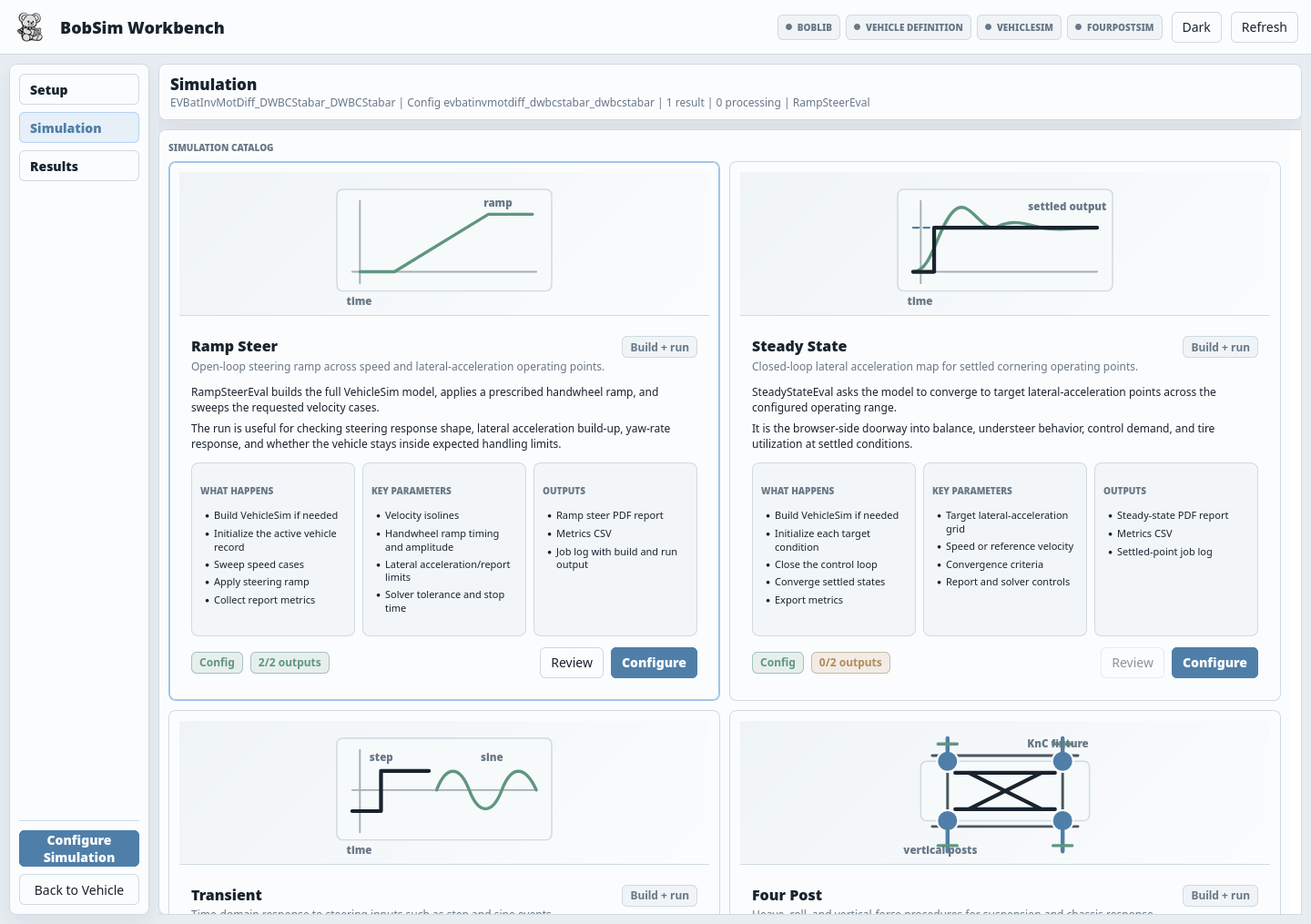
| App card | Workflow | Use it for |
|---|---|---|
Ramp Steer | RampSteerEval | Open-loop steering ramp response |
Steady State | SteadyStateEval | Settled lateral-acceleration operating points |
Transient | TransientEval | Step steer and continuous sine response |
Four Post | FourPostEval | Heave, roll, and vertical-force suspension procedures |
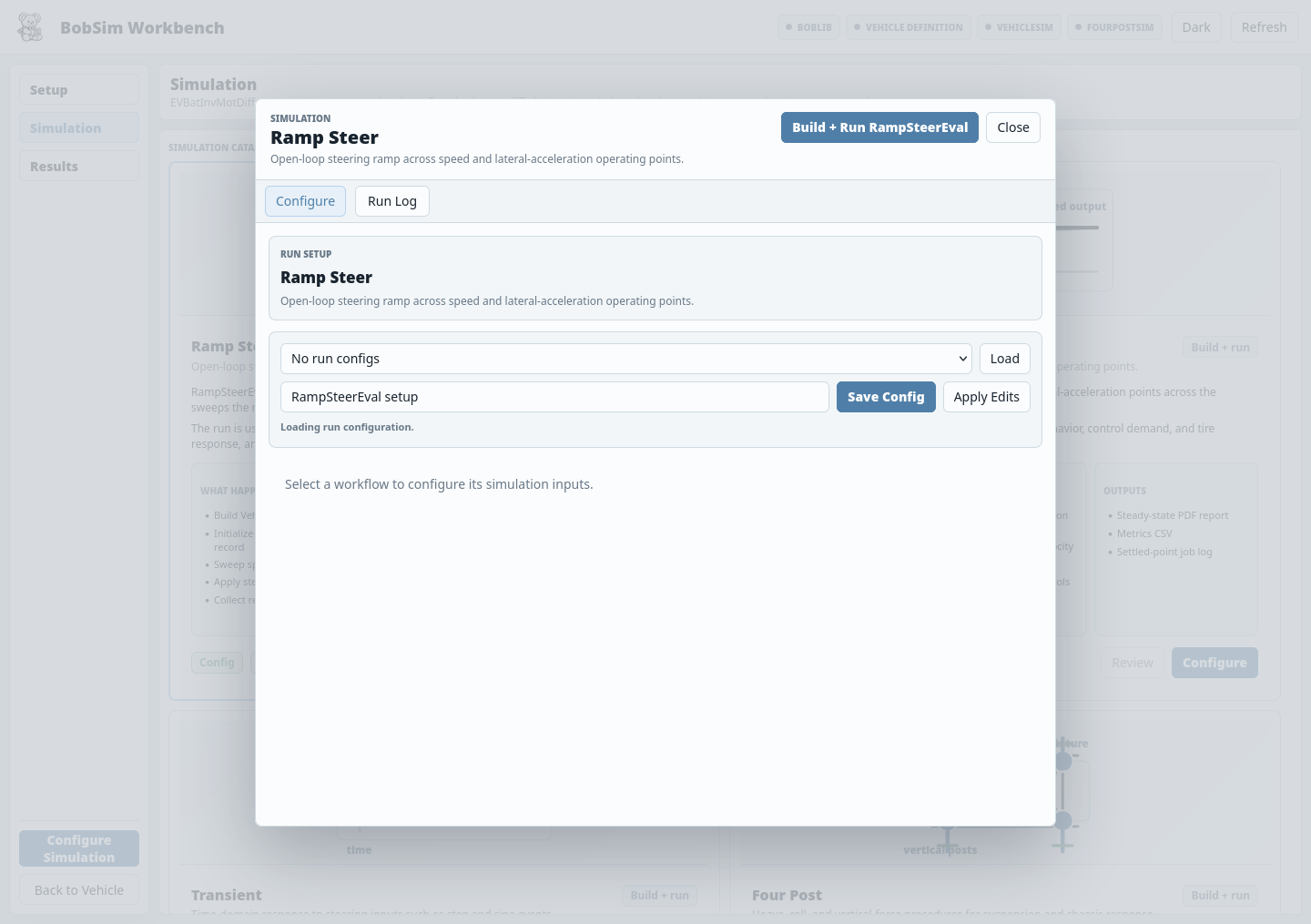
Each card opens a run modal with editable config fields, saved config controls, Build + Run, and Run Log.
Build Targets
| Command | Builds | Output directory |
|---|---|---|
make standard-build | BobLib.Experiments.Standards.VehicleSim | _3_StandardSim/BuildBobLib/VehicleSim/ |
make standard-build-four-post | BobLib.Experiments.Standards.FourPostSim | _3_StandardSim/BuildBobLib/FourPostSim/ |
Both targets compile the active generated BobLib Modelica entry point. The build scripts create the target directories before buildModel(...), and the app also ensures the directories exist before invoking OpenModelica.
Run Targets
| Command | Workflow | Main config |
|---|---|---|
make standard-eval-ramp-steer | Open-loop ramp-steer characterization | _3_StandardSim/RampSteerEval/ramp_steer_eval_config.yml |
make standard-eval-steady-state | Steady-state cornering characterization | _3_StandardSim/SteadyStateEval/steady_state_eval_config.yml |
make standard-eval-transient | Step steer and continuous sine response | _3_StandardSim/TransientEval/transient_eval_config.yml |
make standard-eval-four-post | Suspension/chassis heave and roll sweeps | _3_StandardSim/FourPostEval/four_post_eval_config.yml |
make standard-eval-all | All standard evaluations | All four configs above |
Direct Python module entry points are still available for development:
python -m _3_StandardSim.RampSteerEval.ramp_steer_eval_sim
python -m _3_StandardSim.SteadyStateEval.steady_state_eval_sim
python -m _3_StandardSim.TransientEval.transient_eval_sim
python -m _3_StandardSim.FourPostEval.four_post_eval_sim
Prefer the make targets for public workflows because they rebuild missing executables automatically.
Shared Runner
_3_StandardSim/_modelica_runner.py is the shared execution layer.
For each case it:
- Creates a run directory under the relevant build tree.
- Writes
overrides.txtwith Modelica parameter overrides. - Runs the compiled OpenModelica executable.
- Applies solver, time, output, event, log, and extra runtime flags.
- Reads the generated CSV result file.
- Extracts raw time histories or final steady values.
- Preserves case metadata.
- Removes the run directory when
execution.cleanup: true.
The runner expects these files to exist:
<build_dir>/<exec_name>
<build_dir>/<exec_name>_init.xml
If either file is missing, rerun the matching build target.
On Windows the executable may be written with an .exe suffix. BobSim checks for both forms.
RampSteerEval
RampSteerEval characterizes open-loop steering ramp behavior using the unified VehicleSim executable.
Use it when you want a first handling proof path from the app or CLI. It sweeps configured velocity cases, applies a handwheel ramp, records the vehicle response, and writes report metrics from the measured lateral-acceleration path.
Current config highlights:
| Key | Current role |
|---|---|
simulation.exec_name | BobLib.Experiments.Standards.VehicleSim |
simulation.build_dir | _3_StandardSim/BuildBobLib/VehicleSim |
simulation.init_parameters.useMode | 0, open-loop ramp steer |
simulation.init_parameters.enableLinearityTermination | enables the steering-gain-loss ramp cutoff |
simulation.init_parameters.linearityNonlinearityFraction | local lateral-gain loss fraction that stops the ramp |
simulation.init_parameters.linearityReferenceAy | reference measured lateral acceleration before cutoff evaluation |
sweep.testVels | velocity isolines |
sweep.maxAy | positive ramp target used to choose the ramp direction and report range |
fit.ay_linear_max | linear fit band upper bound |
The app exposes the nonlinearity cutoff controls in the Ramp Steer run config modal. If higher-speed ramp-steer runs stop before the desired lateral acceleration, increase the cutoff fraction or disable the cutoff for that run.
Main outputs:
_3_StandardSim/generated_results/ramp_steer_eval_report.pdf
_3_StandardSim/generated_results/ramp_steer_eval_report_metrics.csv
SteadyStateEval
SteadyStateEval characterizes quasi-steady lateral response using the unified VehicleSim executable in closed-loop target lateral-acceleration mode.
Current config highlights:
| Key | Current role |
|---|---|
simulation.exec_name | BobLib.Experiments.Standards.VehicleSim |
simulation.build_dir | _3_StandardSim/BuildBobLib/VehicleSim |
simulation.init_parameters.useMode | 3, closed-loop target lateral acceleration |
simulation.init_parameters.steadyStateSettleTimeout | timeout after the target ramp reaches its final value |
simulation.init_parameters.steadyStateAyTolerance | settled lateral-acceleration tracking tolerance |
simulation.init_parameters.steadyStateSpeedTolerance | settled speed tracking tolerance |
simulation.extra_args | includes -jacobian=internalNumerical |
sweep.testVels | 12.5, 15.0, 17.5, 20.0 m/s |
sweep.targetAys | available target grid up to 18.0 m/s^2 |
sweep.maxAyByVelocity | default per-velocity caps for feasible alpha runs |
fit.ay_linear_max | linear fit band upper bound |
report.metric_target_velocity_mps | velocity used for exported summary metrics |
The default target list stays broad, but the default app and workflow configs cap generated steady-state cases by velocity:
| Velocity | Default max target |
|---|---|
12.5 m/s | 16.0 m/s^2 |
15.0 m/s | 10.0 m/s^2 |
17.5 m/s | 6.0 m/s^2 |
20.0 m/s | 4.0 m/s^2 |
Remove or raise a cap when intentionally exploring higher lateral acceleration targets. The app exposes these caps and the closed-loop settle tolerances in the Steady State run config modal.
The workflow extracts steering, acceleration, roll, sideslip, yaw velocity, wheel loads, handwheel torque, and controller/debug signals. It fits response curves against measured lateral acceleration and exports gradients, ranges, tracking errors, and velocity trends.
Main outputs:
_3_StandardSim/generated_results/steady_state_eval_report.pdf
_3_StandardSim/generated_results/steady_state_eval_report_metrics.csv

_3_StandardSim/results/steady_state_eval_report.pdf
_3_StandardSim/results/steady_state_eval_report_metrics.csv
TransientEval
TransientEval characterizes steering response over time using step-steer and continuous sine cases.
Current config highlights:
| Key | Current role |
|---|---|
simulation.exec_name | BobLib.Experiments.Standards.VehicleSim |
simulation.extra_args | includes -jacobian=internalNumerical |
test.testVel | 15.0 and 20.0 m/s velocity groups |
test.run_step | enables representative step-steer cases |
test.run_continuous_sine | enables sustained sine sweeps |
test.steerStep_deg | 5.0 degree step input |
test.sweep_freq_hz | 0.5, 0.75, 1.0 Hz |
test.sweep_amp_deg | 5.0 degree sine amplitude |
test.n_cycles | 4 cycles per sine run |
BobLib's integrated vehicle model uses transient tire slip, with relaxation parameters supplied by each tire record. That matters most here because the workflow is explicitly measuring time-domain steering response.
Main outputs:
_3_StandardSim/generated_results/transient_eval_report.pdf
_3_StandardSim/generated_results/transient_eval_report_metrics.csv

_3_StandardSim/results/transient_eval_report.pdf
_3_StandardSim/results/transient_eval_report_metrics.csv
Representative metrics include lateral acceleration rise time, yaw-rate rise time, overshoot, gain, phase, equivalent lag, and frequency-response trends.
FourPostEval
FourPostEval evaluates suspension and chassis response through heave and roll sweeps using BobLib.Experiments.Standards.FourPostSim.
Current config highlights:
| Key | Current role |
|---|---|
simulation.exec_name | BobLib.Experiments.Standards.FourPostSim |
simulation.build_dir | _3_StandardSim/BuildBobLib/FourPostSim |
simulation.extra_args | includes -jacobian=internalNumerical |
procedure.heaveMagnitude | 0.03 m |
procedure.rollMagnitude | 0.02181661564992912 rad |
procedure.forceMagnitude | 1000 N |
report.metrics_csv_path | _3_StandardSim/results/four_post_eval_report_metrics.csv |
report.raw_time_series_appendix | false by default for focused K&C reports |
The workflow extracts front and rear K&C output records and computes summary metrics for camber, toe, caster, KPI, mechanical trail, mechanical scrub, motion ratio, anti/jacking behavior, roll stiffness, anti-roll-bar contribution, and lateral load transfer distribution.
The Geometric Anti-Roll vs Roll report page plots the measured front and rear lateral jacking anti-roll curves across the roll sweep. Raw per-run signal data is still retained in Archive packages when the app saves a run.
Main outputs:
_3_StandardSim/generated_results/four_post_eval_report.pdf
_3_StandardSim/generated_results/four_post_eval_report_metrics.csv

_3_StandardSim/results/four_post_eval_report.pdf
_3_StandardSim/results/four_post_eval_report_metrics.csv
FourPostEval metrics are useful to EnvelopeSim. If available, the envelope loader can use the latest four-post lateral-load-transfer metric; otherwise it falls back to static front mass fraction.
Reports
Standard reports are built by _0_Utils/reporting/report_engine.py.
The report engine:
- reads the workflow config
- creates a title page
- dispatches to workflow-specific summary pages
- renders plots from the
plotsconfig - writes a PDF with Matplotlib
PdfPages
Plot pages are handled by _0_Utils/plotting/plot_engine.py.
Debugging
The fastest debugging loop for maneuver studies is:
make standard-build
make standard-eval-steady-state
For four-post work:
make standard-build-four-post
make standard-eval-four-post
If a run fails:
- Confirm the build directory contains the executable and init XML.
- Set
execution.cleanup: falsein the workflow config. - Rerun the workflow.
- Inspect the retained run directory.
- Check
overrides.txt,run.log, and the generated result CSV.